
Design Journal
Countertop Templating and Installation: A Homeowner's Checklist
Art of Kitchen Tile and Bath · Published October 30, 2026
Quick answer: Before countertop templating, the base cabinets must be installed, level and fastened, and the sink, faucet and cooktop must be on site. At the template you decide seams, overhangs, edges and cutouts, and those choices are final. On installation day the crew sets the stone, and a plumber reconnects the sink afterward.
A stone countertop is cut to fit your kitchen exactly, which is why the steps before the cut matter as much as the stone itself. Templating is the measuring appointment every fabricator works from. A missing sink, a cabinet out of level or a late change can push installation back or add work you pay for.
Related guide: Countertop Buying Guide
What is countertop templating?
Countertop templating is the appointment where the fabricator measures your installed cabinets and records the exact shape of the countertop, including walls, corners, appliance openings and the sink and faucet cutouts. The template, digital or physical, is the record the stone is cut from, so the countertop can only be as accurate as the template.
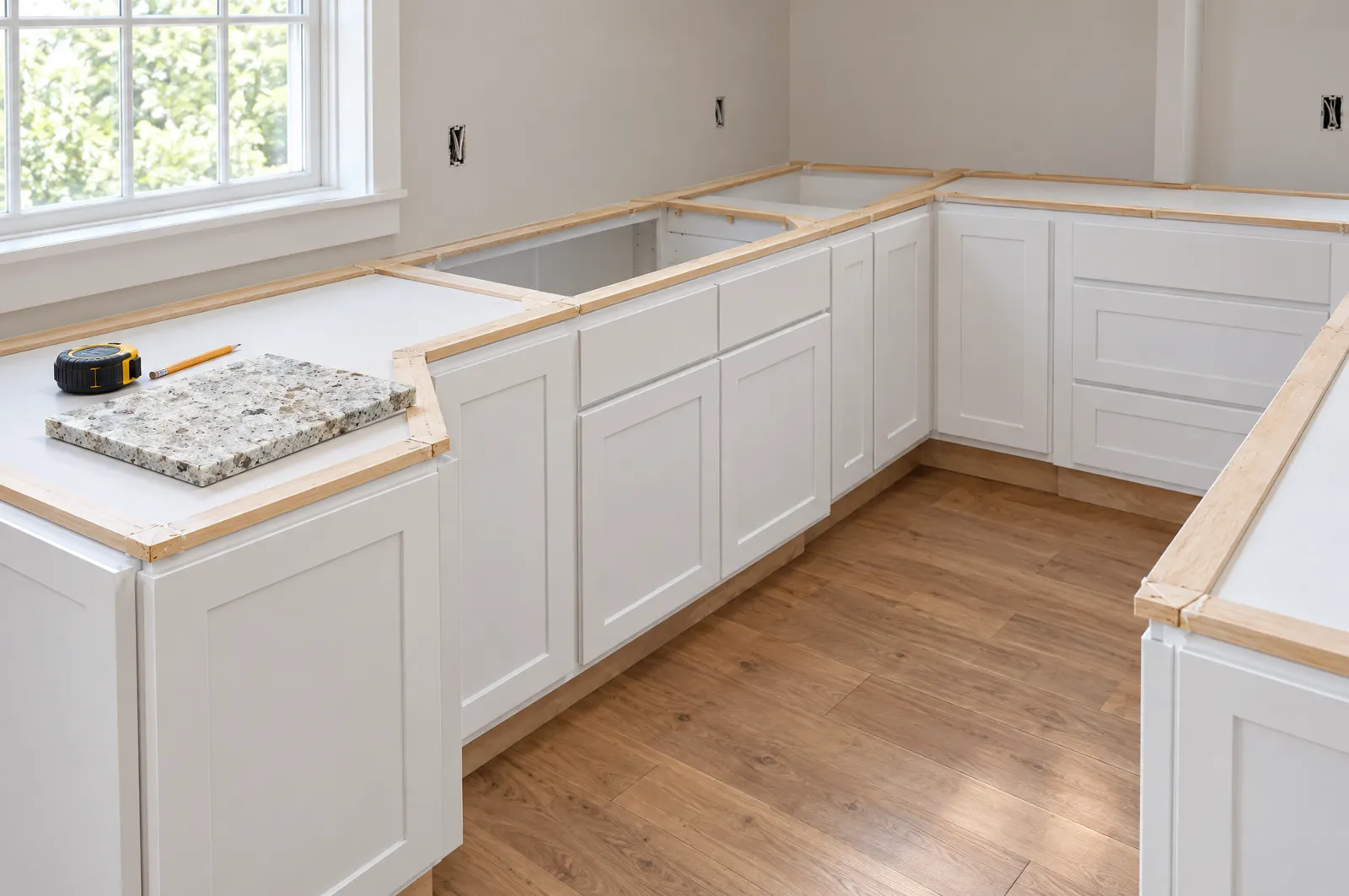
Many fabricators use a digital templating system that measures the cabinets with a laser or a probe; others glue thin strips of wood or plastic into a full-size outline. Both methods work when the cabinets are final.
After templating, the fabricator lays out the slab and often shares a drawing that shows where seams and veining will fall. A homeowner guide from the Marble Institute of America, now the Natural Stone Institute, says the shop drawing stage is when to raise questions on seams and cutouts.
What has to be ready before the template appointment?
Before countertop templating, the base cabinets and any trim that changes the countertop size must be installed in their final position, level and fastened to each other and to the wall. The sink, faucet, cooktop and any other item that mounts in the countertop must be on site so the fabricator can measure the real parts.
The Natural Stone Institute's homeowner guidance says the tops of the cabinets must be within 1/8 inch (3 mm) of flat and level across 10 feet (3 m). When cabinets fall outside that tolerance, the installer will ask for your permission to go ahead, and shims or extra trim work may follow.
Caesarstone, a quartz maker, asks for cabinets that are complete, stable and level, strong enough to carry the stone, and secured to one another and to the back wall.
- Base cabinets installed, level and fastened
- Sink, faucet and cooktop on site, with their spec sheets
- Appliance models chosen, including the range
- Old countertop removed, unless the fabricator removes it
- Someone home who can make final decisions
What gets decided at templating?
At countertop templating you confirm the overhangs, the edge profile, where the seams go, and the exact position of the sink, faucet holes and cooktop. Bring your decisions with you, because the template fixes them. Retailer checklists warn that items and their locations cannot change once the template is made.
Overhang depth is limited by the stone's thickness. The Natural Stone Institute guidance limits an unsupported overhang to 6 inches (150 mm) for thinner (20 mm) tops and 10 inches (250 mm) for thicker (30 mm) tops, and never more than 1/3 of the countertop's width. Deeper seating overhangs need brackets or corbels.
Seams are where two pieces of stone meet. Long runs and L-shaped layouts usually need at least one. Ask where each seam falls, and keep seams away from the sink and cooktop edges when the layout allows.
See also: How to choose a countertop slab
How long between templating and installation?
Countertop installation usually follows templating by one to two weeks, but the gap depends on the stone, the size of the job and the fabricator's schedule. Ask for the installation date at the template appointment, and book the plumber and any backsplash tiler around it, since both work after the stone is set.
A late change to the sink, the cabinets or the edge can mean a new template and a new place in the cutting schedule. Slabs that have to be ordered in, or a large job with many pieces, can take longer.
How do you prepare your home for installation day?
Prepare for countertop installation day by clearing a straight path from the driveway to the kitchen, moving furniture, rugs and breakables out of the way, and emptying the base cabinets. Stone slabs are heavy and carried by hand, so the crew needs room to turn corners and set the pieces down safely.
- Clear the path and protect the floors along it
- Empty the base cabinets and the counter area
- Have the sink plumbing disconnected
- Keep children and pets away from the work area
- Expect some dust if a cutout is finished on site
What happens on installation day?
On countertop installation day, the crew carries in the stone, sets each piece on the cabinets, levels it and bonds the seams. A sink mounted under the stone is attached at this stage, and the crew cleans the surface and checks the joints before leaving. Expect noise while any final cutting or polishing happens.
Cambria, a quartz maker, requires a rigid color-matched adhesive in every seam and full support under field seams, including overhang areas. Caesarstone also asks for support under all seams.
Caesarstone asks installers to leave a small gap between the countertop and each wall for expansion and contraction, at least 3 mm (1/8 inch), and not to fasten sink clips or other hardware directly into the quartz.
When can you use the countertop and reconnect the plumbing?
A new stone countertop needs time for the seam adhesive and sink sealant to cure, and many fabricators ask for the plumbing to be reconnected the next day. The stone installer sets the countertop but does not connect water or electricity, so book the plumber, and an electrician for any countertop outlets, for after installation.
Follow the cure time your fabricator gives you, because it depends on the adhesive used. Until then, keep weight off overhangs and seams, and keep water away from fresh joints.
What should you do in the first week?
In the first week, ask your fabricator whether a natural stone countertop was sealed before installation and when it will need sealing again. The Natural Stone Institute notes that most granite countertops do not need sealing, and that sealing makes stone more stain resistant, not stain proof. Quartz countertops are not sealed.
Wipe spills quickly, especially acidic ones. Lemon juice, vinegar and other acids can dull or etch marble and other calcareous stone, according to the Natural Stone Institute. Use a pH-neutral cleaner and skip abrasive pads.
See also: How to care for stone countertops · Can you replace a sink without replacing the countertop? · Countertops · All buying guides
Frequently asked questions
What does it mean to template a countertop?
To template a countertop means to measure the installed cabinets and record the exact outline, cutouts and edges the stone will be cut to. The fabricator makes the template with a digital system or full-size strips, and the countertop is cut from that record.
How long does countertop installation take?
Countertop installation for a typical kitchen is usually finished in a single visit once the stone is cut. The longer wait is between templating and installation, which fabricators often put at one to two weeks, depending on the stone, the job and their schedule.
Can you change the sink after templating?
Changing the sink after countertop templating usually means a new template, because the cutout is drawn from the exact sink model. Retailer checklists state that items and their locations cannot change after the template, so confirm the sink, faucet and cooktop before the appointment.
Do you need to be home for countertop templating?
Someone who can make final decisions should be home for countertop templating, because the fabricator confirms seams, overhangs, edges and the sink position on the spot. A decision made later can change the cut and delay installation.
Does a quartz countertop need to be sealed?
A quartz countertop does not need sealing, because engineered quartz is not porous the way natural stone is. Natural stone countertops differ: the Natural Stone Institute says most granite does not need sealing, and sealing only makes stone more stain resistant.